
The Central Bureau of Investigation has filed a charge sheet against Ninex Developers Ltd and its director for alleged fraudulent activities in a Gurugram housing project. This marks the 11th charge sheet in the ongoing builder-banker nexus investigation, initiated by the Supreme Court, which involves 50 cases nationwide where homebuyers were allegedly cheated.
The Central Bureau of Investigation has filed a charge sheet against Ninex Developers Ltd and its director for alleged fraudulent activities in a Gurugram housing project. This marks the 11th charge sheet in the ongoing builder-banker nexus investigation, initiated by the Supreme Court, which involves 50 cases nationwide where homebuyers were allegedly cheated.

Real estate developers are increasingly offering flexible payment plans, such as low booking amounts and deferred payments, to stimulate housing sales and manage affordability concerns without resorting to price cuts, as sales volumes declined by 14 per cent in 2025.

Students and families must stress test repayment capacity based on Indian salary standards.

'I don't see fear becoming a dominant factor for retail investors.'

While gold continues to provide safety after its strong 2025 rally, well-chosen real estate investments held with a long-term view remain attractive.

Cape Verde's heroic goalkeeper Vozinha will have his mother in the stands when he next takes to the pitch at the World Cup on Sunday, after US officials moved to ensure she could obtain a visa in time.

From Mollywood Times to Mohiniyattam, these black comedies from South Cinema prove that the darkest humour can also deliver the sharpest entertainment.

Ask rediffGURU Reetika Sharma your insurance, mutual fund and personal finance-related questions.

Bajaj Finserv announced a strategic initiative to invest up to Rs 2,000 crore in artificial intelligence and technology-led startups over the next five years, along with a collaboration with IIT-Bombay for joint research.

Income from renting of properties is taxed at a flat rate of 10%.

With Kylian Mbappe's depth and experience, economists predict France are tipped to edge Spain to lift World Cup.

Immigrants' contribution to the US economy is disproportionate to their share of the population, meaning that losing them would shrink the economy even more than losing a random group of Americans, points out Sree Sreenivasan.

Gram Chikitsalay Season 2 returns with a confirmed connection to Panchayat universe and a more heartwarming narrative, observes Sreeju Sudhakaran.
Krutrim, India's first AI unicorn, has successfully repositioned itself as a focused domestic AI Cloud Services provider, reporting its first annual net profit in FY26.

'I own a few cars that I have had specified minutely to my taste, and it does feel nice to know that there are no other vehicles like them anywhere in the world.'
The Supreme Court of India has upheld an order directing NBCC to complete 16 delayed housing projects of Supertech Limited, providing relief to thousands of homebuyers who have been waiting for nearly two decades.
The Supreme Court of India has upheld an order directing NBCC to complete 16 delayed housing projects of Supertech Limited, providing relief to thousands of homebuyers who have been waiting for nearly two decades.

The Enforcement Directorate (ED) conducted searches at multiple locations in Punjab and Chandigarh, including premises linked to an alleged associate of a Punjab Aam Aadmi Party functionary, as part of a money laundering probe against two realty groups accused of fraudulent land use changes and investor fraud.

Thousands and thousands and thousands of adults owe their lives to the commitment and medical fervour of Dr Armida Fernandez, who a grateful nation honoured with the Padma Shri this year.
The Enforcement Directorate (ED) conducted searches at multiple locations in Punjab and Chandigarh, including premises linked to an official in the CMO, as part of a money laundering probe against realty groups accused of fraudulent land use changes and investor fraud.

Tathastu Realty is investing 500 crore to develop an affordable housing project in Rewari, Haryana, featuring 3,354 flats priced around 30 lakh each.

'In all these years of rupee depreciation, of rising oil prices, of inflation caused by import dependence, not one leader had the courage to look the people in the eye and say: Please do this for your country.'

India's housing finance sector is riding a wave of post-pandemic revival, driven by policy support, digital innovation, and growing demand from younger homebuyers in emerging cities.
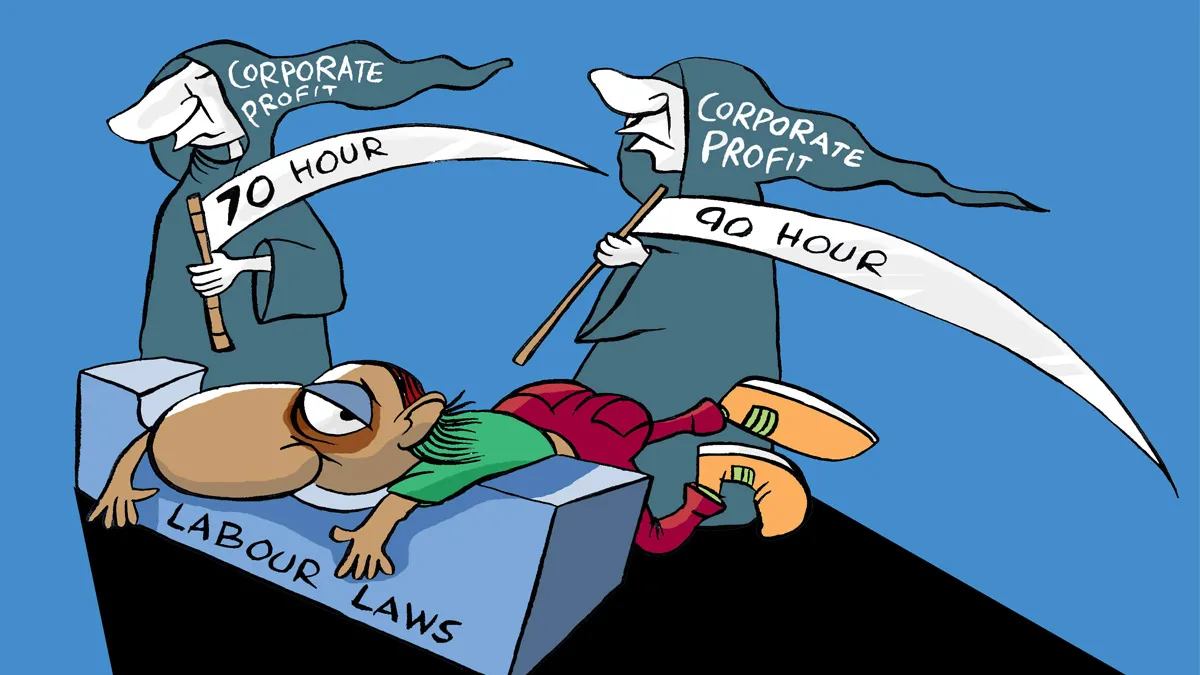
The Indian government has notified final rules under four labour codes, potentially enabling a four-day workweek in certain sectors by capping weekly working hours at 48 while allowing daily flexibility. This move also introduces significant changes to wage fixation, compliance obligations, and social security norms.

'Mamata was more feared than loved, and in politics when people start fearing you then they start hating you.' 'So Mamata's comeback now is impossible.'

Do home prices really never fall? Ramalingam Kalirajan begs to differ.

The banking sector could see better loan growth in the third quarter of financial year 2026 (Q3FY26) with improved net interest margins (NIMs), though the full impact of latest rate cuts will be largely felt in the fourth quarter. There may be lower slippage in unsecured loans and microfinance institutions (MFIs) along with steady recovery trends, which should lower credit cost.

IRCTC is expanding its payments arm, IRCTC Payments, to handle transactions across its ticketing platform and tap government clients, aiming to scale its annual payment processing to approximately 1 trillion.
Researchers at IIT Guwahati have developed a framework for designing earthquake-resistant 3D-printed concrete walls, potentially revolutionising construction in seismic zones.

Karex, the Malaysian company that makes roughly one in five of the world's condoms -- about five billion a year, supplying Durex and Trojan among others -- announced this week that it is raising prices by up to 30 percent. The reason is the Strait of Hormuz.
The Enforcement Directorate (ED) conducted searches in Punjab and Chandigarh, targeting realty groups and individuals linked to an official in the Chief Minister's Office, as part of a money laundering investigation into fraudulent land use changes and investor fraud.

While demand for sub Rs 50-lakh affordable housing prevails, market players cite increased land rates, escalated construction costs and low margins as key prohibiting factors.

'It would be similar to what happened during COVID-19.' 'They are not just losing income, but being pushed into distress.'

The delegations from the US and Iran head to Islamabad on Friday, carrying a ceasefire that is already fraying, a Strait that is technically open and practically closed, and a negotiating agenda that would challenge even parties actually negotiating in good faith, which these groups are not. Prem Panicker continues his must read blog on the Iran War.

Michael remains a passable biopic that looks good, sounds great, and delivers the moments fans came for. But it also feels formulaic in a way that's hard to ignore, notes Mayur Sanap.

Top real estate developers are expected to report improved earnings and resilient presales growth, even as overall housing sales across major Indian cities declined during the July-September quarter (Q2) of 2025-26. The anticipated earnings growth in what is typically a subdued quarter is credited to steady sustenance sales, improved collections, the strong positioning of listed developers, and sustained demand for premium homes.

India's top eight housing markets saw a one per cent decline in sales during the July-September period to 95,547 units, mainly due to lower demand in Mumbai, Pune and Delhi-NCR, according to PropTiger. Real estate consultant PropTiger, recently acquired by listed entity Aurum PropTech Ltd, released its data on Wednesday for India's eight primary housing markets for the July-September quarter.

'Workers are the people who create all the wealth in this country. How can you call them anti-national?'

The US's recent 50 per cent tariff on Indian exports will have a trickledown effect on India's affordable housing, potentially derailing demand as well as supply in this segment, according to experts. Pointing to worker incomes and jobs in micro, small and medium enterprises (MSMEs), and small and medium enterprises (SMEs) that typically make up majority of the customer base of affordable housing, would take a hit in the near terms due to the tariff change, further crippling India's affordable housing sector, already reeling from the impact of the Covid-19 pandemic.
